
Throughout college I felt like I was situated in interdisciplinary limbo, as if I were a soul traveling throughout Dante’s Divina Commedia. Still trying to find my way through this methodological limbo I know I can’t just call myself an early American historian, as I consult material culture sources when studying the past. But then am I an art historian even though I don’t have degrees in art history? What exactly am I?? As we discussed in class, while we need disciplines to define the principles and methods of a field, there can be overlap between disciplines.
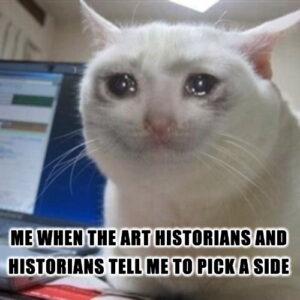
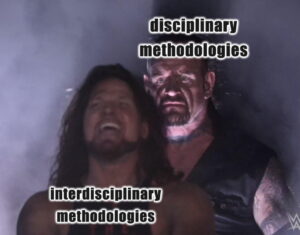
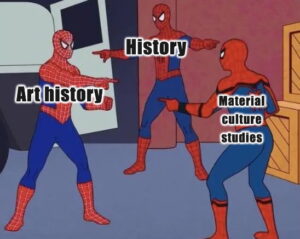
Digital art history is an inherently interdisciplinary field as it “merge[s] technology with interpretative creativity” (Fletcher). Using technological tools to expand upon human creativity, digital art history can both digitally preserve art while also offering new methodologies to analyze it. It can change the way we view and contextualize art and can provide world-wide access to visual sources via the internet (Fletcher https://www.caareviews.org/reviews/2726#.XzwnsC_MxPs; Zweig 39-46).
An example of digital art history’s interdisciplinary capabilities is seen in “Aesthetic Appreciation and Spanish Art: Insights from Eye-Tracking” which discusses an experiment that used eye-tracking technology to track whether or not panel descriptions incorporated alongside works in museums affect how and where a viewer’s eyes roam an artwork. Museums are always concerned about not overloading descriptive panels to not scare off or confuse viewers, so experiments like the one described above can be used by museums to understand how the public prefers to view art and what it is they like to look at. Touching upon the fields of science, art history, and public history, this experiment was inherently interdisciplinary (Bailey-Ross et al., 17-33).
As I’ve said before, I believe that the potential of digital humanities is limitless. Despite being an imaginary recount, Johanna Drucker’s “The Museum Opens” testifies to the potential limitless creativity that can be explored through digital humanities. Imagining the ability to see a huge compilation of works and materials from across the world and multiple museums, Drucker has dreamed up a never-ending museum with a diverse array of cultural experiences attached to it. While this dream like museum provides numerous possibilities for absorbing information about the past, it can also commodify the past, generalize it, and make it seem as if it were an amusement park-like experience (Drucker, 1-16).
A criticism of digital art history is that it pushes aside the humanist principles of art for the sake of compiling metadata, as “A complex human evaluation is reduced to statistical calculation” (Bishop 124). While I don’t wholeheartedly agree with this statement, I do think it is important to remember that as digital scholars, we are both scientists/mathematicians/technicians and humanists grounded in our studies of human individuality and creativity which is something we have touched on before in class (Bishop, 123-129). Counteracting Bishop’s claim that digital art history is solely dehumanizing data collecting, Profs. Arnold and Tilton demonstrate through their article how their method of “distant viewing” uses subjective interpretation for producing metadata which Drucker and Fletcher also discuss in their works (Arnold and Tilton 3-13; Drucker, 1-16; Fletcher; Bishop 123-129).
As I have been discussing in my other classes, despite humanity’s fixation with categorization, interdisciplinary studies capture the diverse creativity, narratives, and multi-faceted complexities of life which we need to understand as scholars of past human experience (Zweig 39-46; Bishop 123-129; Bailey-Ross et al., 17-33; Arnold and Tilton 3-13; Drucker, 1-16; Fletcher).
Ally, I sympathize with your predicament about choosing or deciding on a faculty, i.e. History or Art History. I see my area of interest in a similar manner. I am interested in how modern and contemporary art has been used since the turn of the last century to communicate, market and emphasize particular political ideologies while parodying or satirizing other idea. Now is this art history proper? What does this have to do with Iconography or Formalism? However, I am convinced the topic is still worth exploring. It matters little to me if this can be done in a history or art history department. Would I betray anyone, if I used some digital tools to add Network Analysis of some art dealers or artists to support my thesis? I don’t think so, and anyway it probably doesn’t matter so much if what I find is interesting enough.
Hi Ally! I have so much love for this post! I mean…. you have a cat in it! That said, the substance of what you are writing about is incredibly interesting. I had never really contemplated where material culture was situated in the larger universe of academia. On the one hand, it does seem to be firmly within history, but, of course, many of the objects that you are thinking about are works of art even if they were not created by individuals who society thinks of as artists.
Hi Ally, great post! The interdisciplinary aspect of digital humanities had been one of the more important takeaways for me throughout the semester. I think the view that historians or art historians have to remain in their own disciplinary boxes can have a negative impact on the progression of both fields, and as you mentioned, the digital humanities show what is possible when both disciplines work together. Hopefully those who try to place material culture into a specific category will realize the close-minded nature of their outlook. Additionally, I really appreciated medieval manuscripts and memes being used in the same sentence to highlight the befits of an interdisciplinary approach.
Hi Ally, great post! Thank you for sharing your experiences with “interdisciplinary limbo.” As someone who has had similar feelings in a slightly different context it is reassuring to hear from other folks working through that challenge. I also found your position on Bishop and the critiques of digital art history compelling. There is a balance to be found between data-based approaches and the more qualitative methods of traditional humanities, and I think that path forwarded you have highlighted is the most fruitful.
Also, excellent meme selection. 🙂