
Without a doubt, Module 6 has been my favorite unit so far in the semester. One because I finally understood the software off the bat (lol) and two because I loved how I was able to tap into my historical creativity.
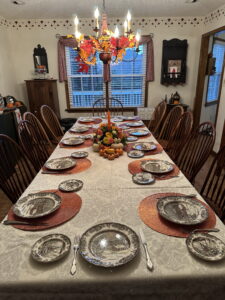
Cary Carson talks about the need to “recreate” the past for those in the present, in his “The End of History Museums: What’s Plan B?” were he argues that museum visitors must be brought into the story to keep them interested and engaged in history. I cannot agree enough with Carson, as my love for history did not sprout from classrooms and textbooks. Rather, my love of history was cultivated through immersion in my maternal grandparents’ home. Everything from the period appropriate wall stenciling that my grandmother hand painted herself to her ginormous collection of pewter, my grandmother painstakingly researched and designed her home to make it feel as if you are in eighteenth-century America. When I say everything- I mean EVERYTHING! The plates, furniture, bedspreads, silhouette images of her granddaughters on the walls, and the butter churner that me and my cousins would lose our minds over, are all period replicas from early America. Trips to grandma’s house are trips back in time!
It’s safe to say that Cary Carson would approve of my grandmother’s decor, as she tapped into her historically informed creativity and reconstructed the past for the present. My grandmother’s superb decorating skills with their time-traveling capabilities, continue to inspire me today, especially when it comes to being a historian. As historians, how do we walk the line between historical accuracy while also creatively approaching the past?
In my course, Study and Writing of History, we have extensively discussed the role of creativity in historiography and the historians who have also tried to explain it (I literally wrote a paper about this topic lol). Zachary Schrag’s The Princeton Guide to Historical Research, Michel-Rolph Trouillot’s Silencing the Past, Peter Novick’s “(The Death of) the Ethics of Historical Practice (and Why I Am Not in Mourning)”, and the AHA’s Standards, agree that historical facts serve as data, while analyses of this data can and should vary. A historian’s particular interpretation of the past requires creativity, but without forgetting about the reality of the facts.
As we discussed in class, creativity can be a scary word for historians. No historian ever wants to be in violation of the American Historical Association’s Statement on Standards of Professional Conduct, which can happen if you take too many creative liberties with your historical account. History is NOT historical fiction- meaning historians do NOT make up the facts (https://www.historians.org/resource/statement-on-standards-of-professional-conduct/).
Like Anne said in class, historians can add some creative-writing flare to their historical interpretations. Whether that’s through taking the time to describe scenery or reconstruct the bustling streets of early New York City like what John Wood Sweet does in his The Sewing Girl’s Tale, this creativity can assist in enveloping the reader within the story, (as Cary Carson would have wanted). I employed some creative-writing flare in my own work, as I placed readers in downtown Norfolk by describing the current environment of the Myers house in stark contrast to my description of the dirty and disease-filled eighteenth-century Norfolk.
Historians can draw in people of the present into the past, by using digital history tools such as “Choose Your Own Adventure” activities. Through Twine, Paige and I were able to create a simulation of what life could be like for a young woman in medieval Italy. We were both horrified by the limited options that women faced. Kate Heartfield’s “The Road to Canterbury” is an online game/novel that blends historical text with interactive features that make players’ decisions central to the progression of the story. Your involvement with the story makes you all the more intrigued to see how things will turn out! (https://www.choiceofgames.com/road-to-canterbury/credits.html; https://www.choiceofgames.com/road-to-canterbury/).
Cait S. Kirby’s interactive simulation of a day-in-the-life of a student during the COVID-19 pandemic serves as a useful exercise in understanding differing human experience and emotion. Players make choices within the context of the academy during the pandemic, allowing them to explore the consequences of these actions and the subsequent emotion they invoke. Emotion is something that every human being can relate to, and exploring this relatability can assist with historical immersion, as seen in Kirby’s work. (https://archive.is/20200703112628/https://www.chronicle.com/article/A-PhD-Student-Simulated-a/249106; https://caitkirby.com/downloads/October5th2020.html).
Cary Carson and my grandmother taught me that history is more interesting when you are incorporated into it, as we have seen in Heartfield’s and Kirby’s interactive digital history experiences, which make their audiences feel invested in the story by enveloping them within it. When it comes to crafting historical interpretations, historians need to channel Carson by embracing their historically informed creativity without sacrificing the standards of the historian (as discussed by Schrag, Trouillot, Novick, and the AHA) as this makes history come alive in the present.
Ally
Hi Ally, would your grandma like to adopt a 23 year old grandchild? The course you mentioned sounds really interesting and gives you a unique perspective I enjoyed reading.
I thought your use of creative description in placing readers in downtown Norfolk, contrasting the present-day environment of the Myers House with the dirty and disease-filled eighteenth-century city, was especially effective.
I also really liked your closing comment: “Cary Carson and my grandmother taught me that history is more interesting when you are incorporated into it.” That insight stood out to me. As you noted, Heartfield’s and Kirby’s interactive digital history experiences show how inviting audiences into the narrative makes them more invested. When crafting historical interpretations, historians should indeed channel Carson’s spirit by embracing historically informed creativity while still upholding the standards of the discipline. Great post!
Hi Ally! Awesome post! I would love to see more pictures of your grandmothers house at some point. She sounds incredible! I do agree with you regarding museums. Museums (and other public spaces) are an excellent door into history. I was also first interested in museums and then in academic history. I like your point about creativity and the “reality of data.” In theory, the data remain the same, but interpretations may change either based on new data (evidence) or a different way of looking at the same information.